The infrastructure challenges reshaping media
Insights from the DPP Leaders’ Briefing
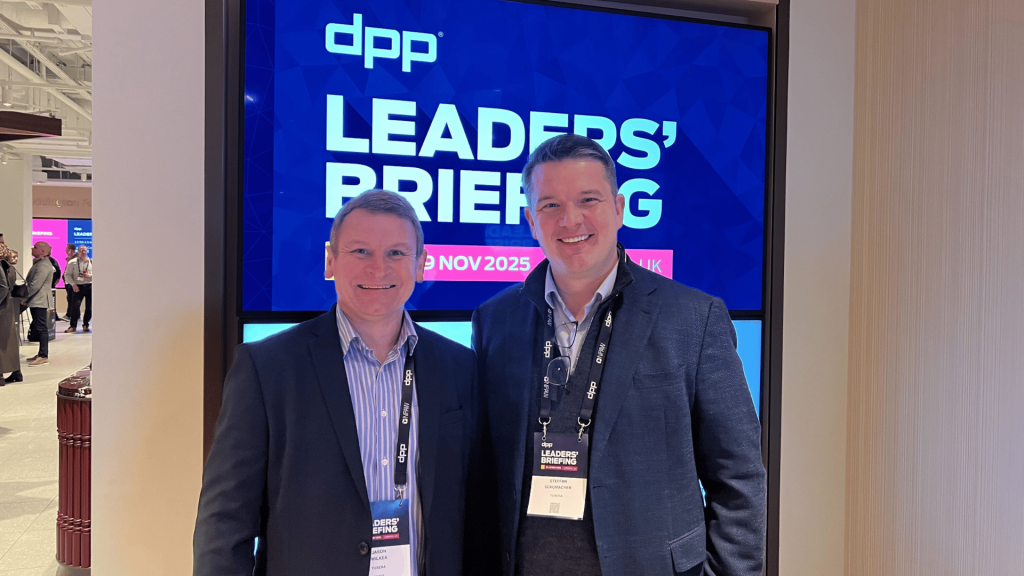
The DPP Leaders’ Briefing in London brought together senior leaders from across the media and technology ecosystem, including Warner Bros. Discovery, BBC Studios, Amazon Studios, YouTube, TikTok, The Associated Press and Sky. For Tuxera CEO Steffan Schumacher and EMEA Sales Director Jason Wilkes, the event offered a clear view of how the broadcast industry is navigating a critical inflection point.
What made the conversations particularly striking was how closely they mirrored patterns emerging across other sectors. In a week that saw Tuxera teams active across media, supercomputing, utilities, aerospace and enterprise IT, one theme emerged repeatedly: performance is becoming the real bottleneck. Not computing power, not storage capacity, but the efficiency with which data moves through infrastructure. “Innovation now depends on how efficiently data can move,” Steffan notes in his reflections on the event. “When it slows down, so does the entire system. When it works, progress accelerates.”
AI as the core operational layer
“AI was present in almost every keynote,” Steffan notes in his reflections on the event. “It is reshaping news production, content supply chains, monetization, audience engagement and automation. The message was simple: AI is no longer a future ambition. It is becoming a core operational layer.”
Jason’s observations reinforced this shift. “The industry has moved beyond asking whether to adopt AI to addressing how to make it work at scale.” Yet underlying these advances sits a fundamental requirement: “For AI to work at scale, the underlying data layer must be fast, flexible and reliable.”
The data-intensive nature of AI-driven workflows means that protocol bottlenecks become critical constraints, amplifying pressure on infrastructure that was never designed for these demands.
Beyond the cloud: hybrid architecture becomes essential
“The industry is moving toward hybrid and distributed architectures, where performance matters in every location, not just in centralized cloud environments,” Steffan explains. “This shift fits closely with the direction we are taking with Tuxera Fusion as customers look for high performance file access across workflows and platforms.”
Jason’s conversations revealed the practical implications: organizations need to support virtual production, handle 4K and 8K content, and enable real-time collaboration across multiple sites. The traditional approach of accepting protocol limitations and building workarounds simply doesn’t work anymore.
Innovation capacity as competitive advantage
Leadership across the industry reinforced that success depends on the ability to innovate, experiment and scale. “Efficiency targets of around 20 percent were mentioned several times,” notes Steffan. “Companies need partners who can help them get more value out of what they already have.”
With budgets flat or decreasing while time-to-content must shorten, organizations that can remove infrastructure bottlenecks gain competitive advantage precisely because their infrastructure enables rather than constrains innovation.
Navigating with data as your compass
One particularly resonant keynote used Ernest Shackleton’s Antarctic expedition as a metaphor for the industry’s current position. Jason found this analogy especially compelling given the parallel challenges facing media organizations. “The speaker emphasized that companies cannot control the external environment – the rapid changes in technology, audience behavior, and competitive landscape,” he explains. “But they can control how prepared they are, how fast they can adapt, and how good their data and insights are.”
“Companies cannot control the external environment, but they can control how well they navigate it,” Steffan reflects. “Data, insight and speed will be the compass. This resonated strongly with the role Tuxera plays in enabling performance and clarity across complex environments.”
“When you’re navigating icy waters, you need to trust that your fundamental systems will work precisely when you need them,” he adds. Just as Shackleton’s expedition needed equipment that functioned flawlessly in extreme conditions, media operations need infrastructure that performs reliably under pressure.
Content workflows in transition
“Distributed teams, new formats, hybrid production, real-time requirements and tighter budgets are creating pressure,” observes Steffan. “At the same time they are opening new opportunities for companies that can innovate quickly and help customers remove bottlenecks.”
Content creation has transformed from teams in single locations to globally distributed operations. The infrastructure supporting these workflows must evolve simultaneously, delivering performance that enables rather than constrains creativity.
Infrastructure excellence enables creative excellence
Across all the themes discussed at DPP – from AI integration to workflow modernization, from hybrid architectures to efficiency demands – one insight emerges clearly: high-performance data access is becoming a strategic requirement.
“The relevance for Tuxera is very clear,” concludes Steffan. “Fusion is well positioned to meet these needs, and the conversations we had during the event confirmed that.”
Protocol performance is increasingly the difference between teams waiting for infrastructure and infrastructure that enables creativity. The companies that thrive will be those who understand that creative excellence demands infrastructure excellence.
Read Steffan’s full reflections from the DPP Leaders’ Briefing for deeper insights on these industry shifts.
Tuxera Fusion SMB delivers enterprise-grade file sharing performance that eliminates protocol bottlenecks in demanding workflows.
Learn more at tuxera.com/products/tuxera-fusion-smb
Get in touch to start you Fusion SMB evaluation