


Tuxera at IBC2025
How protocol optimization is transforming media workflows when every second counts IBC, the International Broadcasting Convention, stands as Europe’s premier...
We are here to help
Have a question or need guidance? Whether you’re searching for resources or want to connect with an expert, we’ve got you covered. Use the search bar on the right to find what you need.

Heya folks, it’s Ned Pyle again with news: QUIC is coming to Fusion SMB.
SMB over QUIC adds security and connectivity to cloud computing and storage platforms. Fusion SMB is state-of-the-art for Linux file servers, and SMB over QUIC is as cutting edge as it gets. Let’s talk about it.
QUIC is a transport protocol. Its designers seek to solve problems with TCP discovered over 50 years.
QUIC is the basis of HTTP/3, which runs on 35% of the world’s websites and growing at 5% annually. QUIC’s not the future – it’s now.
Trivia item 1: Despite what you may have heard, QUIC is not an acronym.
SMB over QUIC is a VPN without headaches. It works on networks that often block port 445 over TCP – such the Internet and DMZs. You can use SMB over QUIC inside a network for added safety, but also at the edge of your network, in cloud tenants, and as a hybrid solution joining everything together. Because QUIC is just a different transport, applications and users require no new code or training. QUIC traffic is on UDP/443 by default, making scenarios like on-prem client connections to AWS EC2 instances a snap.
But QUIC also adds security that’s superior to SMB 3’s built-in encryption. Consider this scenario:
A client is connecting to a share called “TV” on the “Media-PP09” file server in a post-production editing studio. Out of the box, there’s no encryption; if the client is Windows 11 24H2, SMB will sign by default – meaning the data is safe from tampering and credential relay attacks – but nothing more.
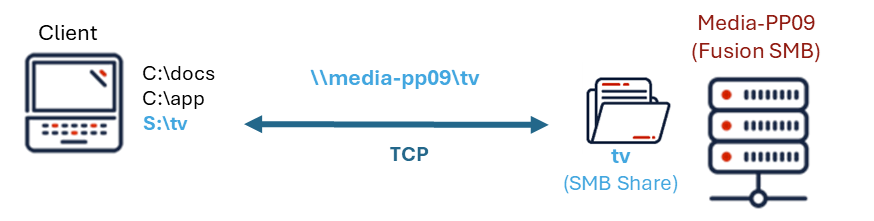
If we require SMB encryption from the client using Group Policy, PowerShell, or mapping commands, we add data privacy:
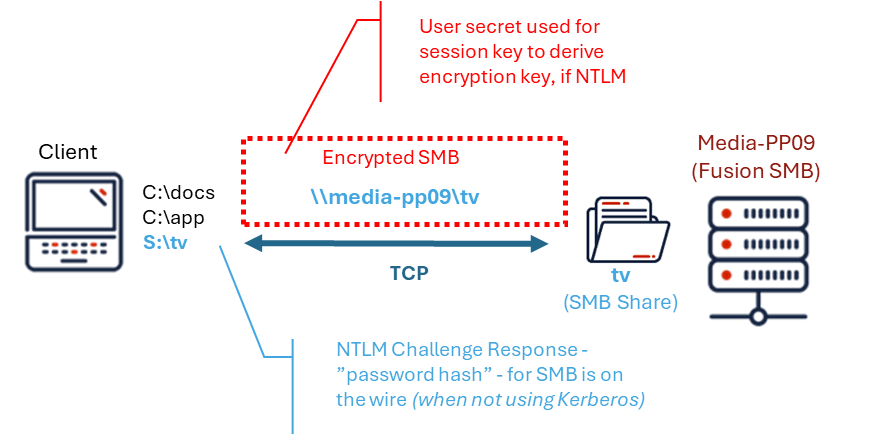
Notice the caveats. Since TCP itself isn’t encrypted, privacy is application layer and the user’s own session key derives the encryption key. This means the user’s auth is before SMB encryption starts and is only as strong as the user’s password. With Kerberos, the shared secret is never involved directly with SMB, the session key comes from the Authentication Service Request and AES-256. But NTLM is very vulnerable because the so-called “password hash” – the result of the challenge response – is actually on the wire in order to encrypt and it uses weak HMAC-MD5 cryptography.
When we add QUIC, security improves dramatically: TLS 1.3 uses a certificate with strong modern cryptography to create a tunnel. QUIC encrypts the entire SMB conversation, keeping even NTLM safe between the client and server for SMB authorization. Nothing changes for the user or application – they don’t get additional prompts or steps. It’s just like a VPN, without the setup, training, and cost:
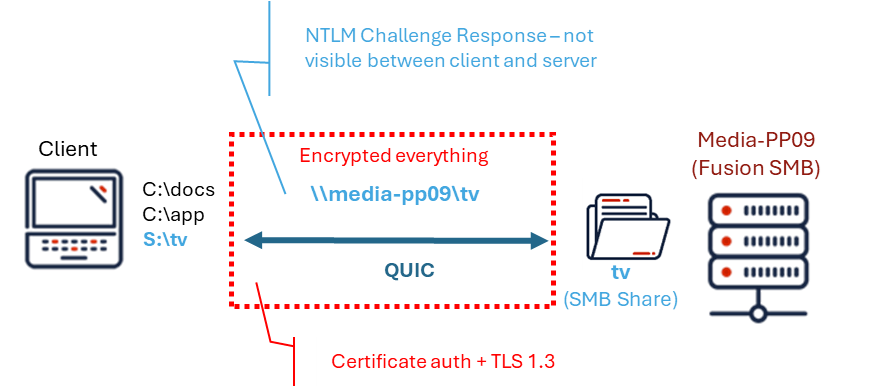
You can see why Microsoft finally deprecated NTLM! Kerberos doesn’t have NTLM’s architectural problems, has much stronger cryptography, and supports mechanism other than passwords. Microsoft, Apple, and Linux will all end this legacy chapter by supporting Local KDC and IAKerb, as shown in this talk. Hey, I know that guy!
Trivia item 2: Before I was the owner of SMB 3 and architect of SMB over QUIC at Microsoft, I worked on Active Directory.
But enough theory – let’s see it work! Here’s a demo of our SMB over QUIC preview:
When Microsoft originally released SMB over QUIC, they restricted it to Azure. My final move before leaving was to include it in Windows Server 2025. The genie is out of the bottle and broad interest in QUIC has naturally skyrocketed.
It’s worth a reminder that Tuxera is a Microsoft patent licensee, which brings legal safeguards to all our customers, unlike the GPLv3-based Samba. But that license program also encourages us to quickly follow Microsoft’s SMB innovations.
As soon as QUIC was universally available for Windows, we decided to build a version for Linux. Just like we did with every other SMB 3 feature over the past decade. Tuxera keeps Fusion SMB state-of-the-art.
SMB over QUIC helps organizations with their high security threat scenarios, like medical research and post-production media. It also brings flexibility to difficult networking situations, like hybrid cloud and mobile users.
Tuxera will have Fusion SMB over QUIC production ready and released by the end of the year. We will show off our preview release live at SC25 this November in St Louis – I hope to see you there.
Ned Pyle, Enterprise Storage Technical Officer, Tuxera
Find out more about Tuxera Fusion SMB on the product page.
RELATED ARTICLES

How protocol optimization is transforming media workflows when every second counts IBC, the International Broadcasting Convention, stands as Europe’s premier...

Heya folks, it’s Ned Pyle again. Let’s talk about how Tuxera Fusion SMB stacks up to its Linux community alternative, Samba....

How collaboration with industry leaders is transforming media storage performance Following our award-winning presence at NAB Show 2025, where Tuxera...

Heya folks, it’s Ned Pyle again. Last year I talked about how Fusion SMB stacks up to Samba in enterprise workloads. If you run or integrate cloud, machine learning, media & entertainment, or HPC services, Fusion SMB is the right choice for Linux file servers. But...
Suggested content for: